AI reshaping IT jobs: Growth in security, decline in support roles


Whether you’re a seasoned IT professional or just looking to break into the world of tech, you need to know whether your job will be in demand in the years to come, and how you can remain relevant even in a competitive job market.
Thankfully, someone has already done a lot of the hard work for you. The U.S. Bureau of Labor Statistics (BLS) regularly shares 10-year employment projections to help workers understand demand for various job titles in the not-so-distant future, across a wide range of professions.
The good news about IT jobs
Overall, the number of jobs in the U.S. is expected to grow by 3% over the ten-year period between 2024 and 2034. IT jobs are expected to fare far better, with a projected employment growth of 10% during the same period.
According to the BLS: “Computer and mathematical occupations are projected to grow the second fastest of any occupational group (+10.1 percent), which is more than three times the average rate of growth projected for the total economy (+3.1 percent).”
While the BLS called out cybersecurity as a driver of IT job growth, amid a high “frequency and severity of cyberattacks and data breaches on U.S. businesses,” they also had much to say about the impact of artificial intelligence (AI).
The impact of AI on the U.S. job market
Here’s a bit of bad news: The BLS believes that AI will erode demand for many jobs, especially those held by office and administrative support workers and sales workers who engage in activities such as “routine calls, chats, and analysis.”
But at the same time, the BLS also believes that AI will create opportunities in the tech job market, stating: “Demand for artificial intelligence (AI)-based systems, data processing, software development, research services, and associated consulting services are expected to drive the need for workers in both the professional, scientific, and technical services sector (+7.5 percent) and the information sector (+6.5 percent).”
But how will AI impact specific information technology roles?
The ten-year outlook for IT professions
According to the BLS, demand for several IT profession jobs is expected to be very strong. With 28.5% projected job growth over 10 years, information security analysts are among the top 5 fastest-growing occupations in the U.S. Also, at 15.8% and 15.2%, respectively, software developers and computer and information systems managers broke into the top 30.
The ten-year job growth projections are also particularly positive—2x to 3x the average—for the following occupations: Computer network architects (+12%), Software quality assurance analysts and testers (+10%), Database architects (+9%), Web developers (+8%), and Web and digital interface designers (+7%).
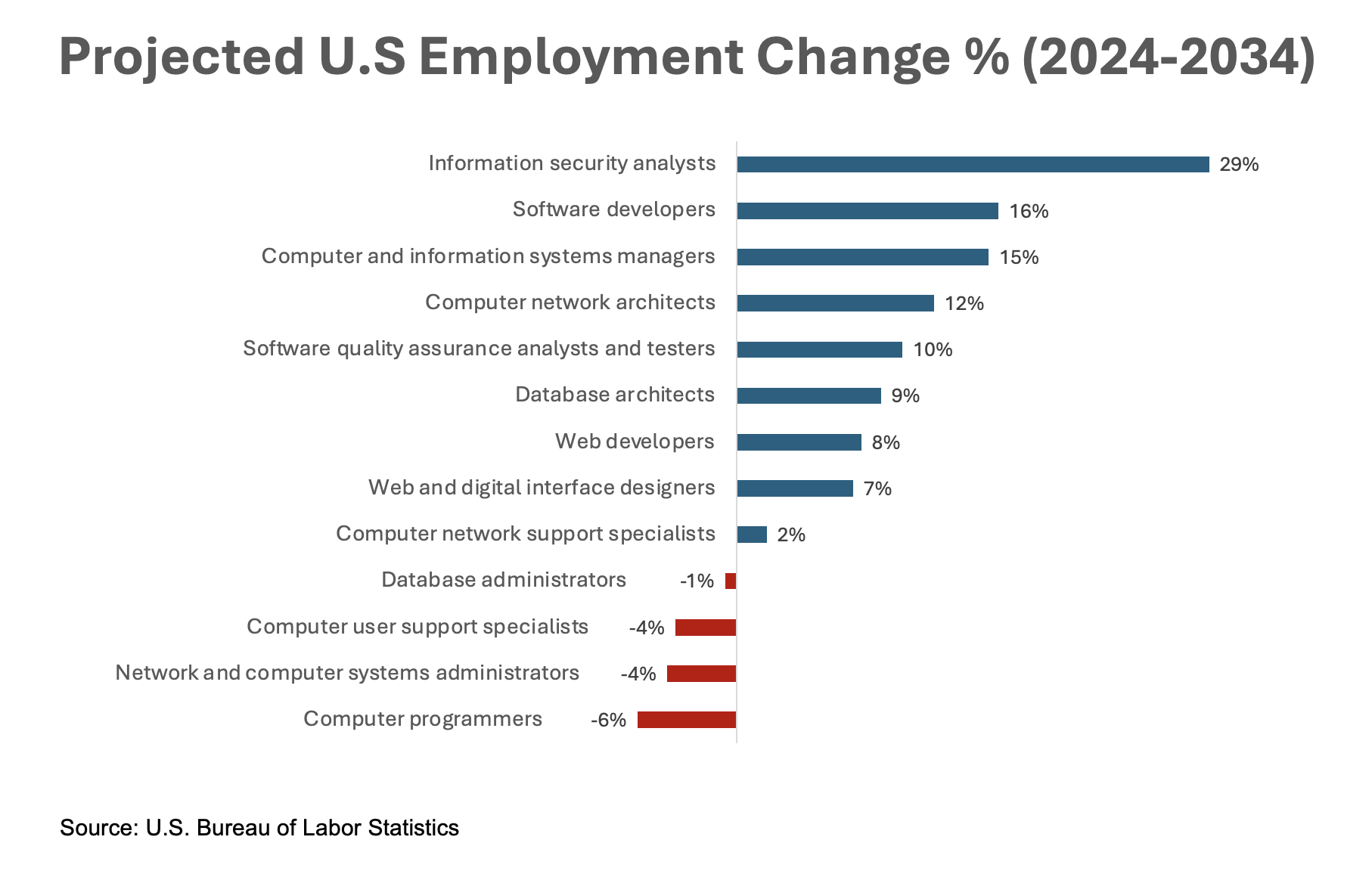
Demand for 4 popular roles is expected to contract over the next 10 years: Database administrators (-1%), Computer user support specialists (-4%), Network and computer systems administrators (-4%), and computer programmers (-6%).
Note that the IT jobs projected to drop in demand are junior roles, where demand for their more senior counterparts — software developers, network architects, database architects — is expected to grow.
Why will demand for some IT roles decrease?
The BLS suggests three related reasons demand for some IT roles will shrink: automation, outsourcing to as-a-service providers, and tasks being shifted to more senior employees.
The BLS elaborated on these factors in its job outlooks for several IT roles. Below are examples explaining the BLS’s reasoning for why demand for some roles will decrease while demand for others will grow.
“Network and computer systems administrators will continue to be needed throughout the economy to maintain and upgrade computer networks. However, some of their tasks are increasingly being done by software developers focused on DevOps (development operations), and some tasks are being outsourced to companies who provide Networks-as-a-Service. Additionally, systems administrators are increasingly automating routine tasks.”
“Computer programming work continues to be automated, helping computer programmers to become more efficient in some of their tasks. To save time and money, many companies are expected to leverage technologies, including artificial intelligence (AI), to automate repetitive programming tasks. In addition, some higher-skilled programming tasks will likely shift to other workers, such as software developers.”
“Employment growth of computer network support specialists is expected to be constrained because some businesses, especially smaller organizations with minimal information technology (IT) requirements, may find it more cost-effective to contract with outside firms for these services rather than to employ computer network support specialists. Some of these workers also may be replaced by computer network architects because of a computer industry shift towards workers with broader skillsets that include design skills. However, the importance of strong network and other IT infrastructure will support some demand for computer network support specialists.”
The case for IT optimism, despite declines in some areas
I’ve written about the BLS projections for a few years now, and we can revisit historical data to understand how BLS opinions have changed over time.
While it’s true that four out of the 13 IT occupations we’re tracking are expected to experience negative growth over the next 10 years, that doesn’t mean that IT is no longer a worthwhile profession to pursue a career in. In other words, this recent news is not all doom and gloom.
Despite some bad news, it’s important to reiterate that demand for most occupations in the IT field is expected to grow faster than the national average, and even entry-level roles pay well above the national median salary.
It’s also important to look at the big picture. Projections are predictions that may or may not come true, but actual employment figures track what has actually happened.
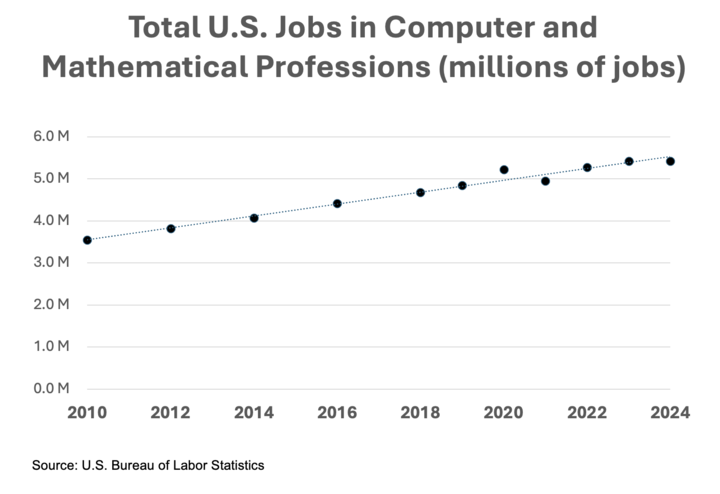
The long-term trend for jobs in tech and mathematical professions has been overwhelmingly positive over the last 14 years — jumping from 3.5M jobs in 2010 to 5.4M in 2024 — since the BLS started publishing employment projections.
Even in roles that are predicted to be on the decline, there’s still hope for those looking to get into IT. The BLS offers the following insight: “Despite declining employment, about 14,300 openings for network and computer systems administrators are projected each year, on average, over the decade. All of those openings are expected to result from the need to replace workers who transfer to other occupations or exit the labor force, such as to retire.”
How IT professionals can get ahead in the age of AI
Anyone looking to advance their career in the IT field needs to remember a few key things.
While it will likely become harder to land an entry-level role in IT, the overall number of jobs in IT is expected to increase. As they stated repeatedly, the BLS believes that support tasks that can be easily automated will be handled by AI-powered chatbots. That means that IT professionals need to evolve their skillsets amid the new AI normal.
As always, the only constant in tech is change. Technology doesn’t stand still, and neither can you. IT professionals must always keep learning to keep up with the latest advancements and stay relevant in their field. Today, those latest advancements come in the form of AI, where before they might have been in virtualization or cloud computing.
Tomorrow, it will be something else. The important part is to evolve what you bring to the table (whether technical or soft skills) so that you can continuously deliver value to your organization, and survive and even thrive amid the ever-shifting winds that will inevitably come in the future.