Using AI to Enhance Video Marketing Strategy — Internal Efficiency and ROI
In the first part of the two-part series, Jenna Bunnell, senior manager, content marketing, Dialpad, discussed how AI helps video marketing improve customer experience and engagement. In the second part, she discusses how it helps in improving internal efficiency and ROI.

Artificial Intelligence (AI) is becoming a huge part of many industries and business operations. Video marketing is no exception.
In the first part of this two-post series we delved into the more customer-facing benefits of using AI in your video marketing campaigns. Now, we’re going to get into the internal and operational advantages.
Making the Most of What You Have
In all marketing, you want to make the most of your resources. That means making your team as efficient as possible and making your assets work as hard for you as they can.
AI can help in both areas.
See More: How to Optimize Branded Video Content With Stock Footage
Derive more value from your assets
How are brands delivering hyper-personalized and valuable content and ads to their audience? Fortunately for marketers, they can use AI to capture customer video insights to extend the reach of their video marketing and become even more usefully responsive. With the right AI-powered video platforms, brands can harness in-depth insights, sometimes in real-time, and produce the kind of customized content that drives results.
Brands can also use platforms that enable the integrations they need most, such as with their CRM. Integrating risk mitigation into your migration if you need to transfer your data for ease of access or additional storage can be done using various strategies.
All this means going beyond basic metrics. And AI tools give marketers more granular insights — how viewers are engaging with their videos — so they can maximize ROI. Artificial intelligence capabilities allow them to wring more value from their content because they can translate data into insight into the optimal marketing strategy.
Marketing teams can comb through the wealth of video data points and leverage this understanding to initiate outreach across multiple channels. And they can identify problems their audience is trying to solve, where they are in the buyer journey, or insights about follow-ups or further information that could turn a lead into a customer.
Marketers can use AI to analyze video content marketing data. This data can be utilized to make a video shorter and more engaging if necessary or to understand what you are doing well to repeat it in future videos.
AI means using data, not guesswork.
Maximize your ROI
When marketers combine the power of video engagement with artificial intelligence tools and platforms, they can boost conversions and increase their revenues. And AI helps them meet the challenge of their video marketing strategy.
It means they can create videos targeted to guide customers through the sales funnel and use analytics to follow up far more effectively, although there is a limit to lead follow-up. They can analyze how long customers engaged with video content and segment their audience into groups according to which videos they watched and for how long.
By using segmentation software, it is possible to build a timeline of the viewer’s journey. Marketers can also identify clusters of activity and build customer profiles.
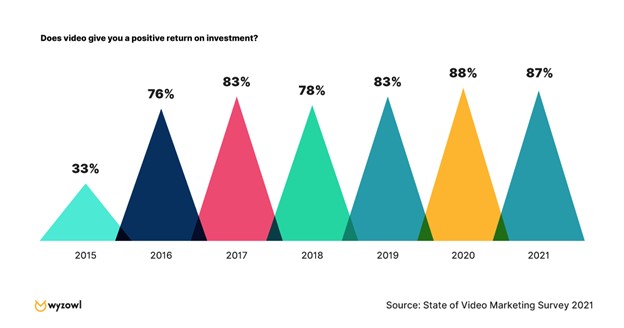
Maximize your ROI
Source: State of Video Marketing Survey 2021
With better insights into customer viewing habits, sales teams are also better placed in their interaction with customer leads and have reasons to engage. The metrics delivered by artificial intelligence and automation tools can be a valuable differentiator that fuels video marketing campaigns that yield insight into audience intention and convert more leads without increasing workload.
Take emotion-detection apps used by video marketing teams to track responses to video content. These software tools use machine learning to recognize facial expressions and try to measure the emotions elicited by different video content. The software uses deep learning to update and learn from enormous databases of analyzed faces by recognizing scores of common facial expressions and mapping them to universal human emotions such as anger, disgust, fear, sadness, and surprise. By comparing responses to products to determine which resonate best and are most likely to perform well, marketing teams can boost their bottom line.
When they nail their video marketing strategy, ambitious omnichannel businesses, for example, will not have to ask, ‘what is inventory management in retail?’ – They will already have it in place to manage their sales growth.
More efficient video production
Other software, such as Magisto, uses AI to allow brands to create video content for their marketing research. This research then delivers insights for businesses into customer viewing behavior, such as when and where viewers stop watching video content and what content moves them to make the most purchases.
The application does this by uploading existing footage and images and asking users to choose an editing style from various moods and accompanying soundtracks. The software then filters the users’ selections through its machine learning capabilities to recognize, analyze, and marshal different elements — action scenes, facial expressions, and speech — to create a storyline.
Finally, the app mashes this up with a range of professional effects and free-to-use content to produce a movie, publishable on various channels such as social media, email, and video platforms.
See More: 6 Video Elements You Should Always A/B Test
What is the purpose of this use case of AI-assisted video marketing?
One firm, Hampton Beach Casino Ballroom, reported leveraging these videos in evaluating their video marketing campaigns to increase ticket sales and engagement. The software allowed the firm to A/B test their machine-learning-created video ad against traditional image-based ads. (Split test your affiliate programs, as this is another increasingly vital part of your video marketing strategy). It also helped them rustle up videos in a fraction of the time it would otherwise take, and quick testing means more room for iteration.
As we can see, artificial intelligence is beginning to transform video marketing by allowing companies to experiment and run tests with video generation software and use analytics functionality to garner insights and make sense of results.
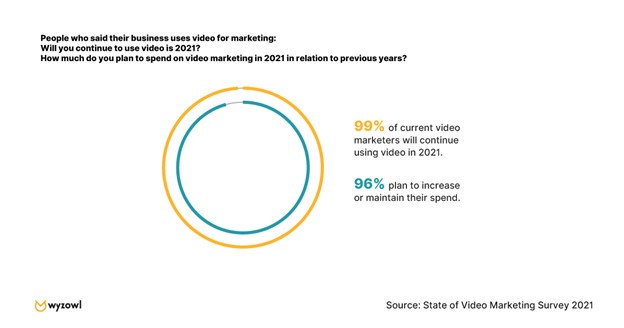
What is the purpose of this use case of AI-assisted video marketing?
Source: State of Video Marketing Survey 2021
Traditionally, producing first-rate video content would require formidable talent and potentially prohibitive investment. But with AI, even businesses with smaller budgets without an in-house production team can get in on the act. And they can even do so remotely while keeping in touch via reliable unified communications tools, perhaps an alternative to RingCentral.
Wrapping Up
Marketers are adapting to the avalanche of video. But without AI, orchestrating the volumes of data in question is a daunting prospect. Leveraging these tools, however, they can adjust their campaigns, reduce the time it takes to deploy them, deliver more engaging customer experiences, and drive results. Because integrating data can deliver exponential outcomes.
Have you used AI in video marketing? How has it impacted your internal efficiency and ROI? Let us know on Facebook, Twitter, and LinkedIn.
MORE ON ARTIFICIAL INTELLIGENCE