53% of CHROs Believe Job Market Will Favor Employers Over the Next Year
The constant economic upheaval and other factors pose risks and threats to businesses this year. PwC recently conducted a pulse survey to understand how company leaders and leaders of various business functions are managing risks. Here are a few insights from the perspective of CHROs and HR leaders.

The business environment has been continuously shifting over the last two years. First, there was the COVID-19 pandemic, which led to remote working and hybrid work. Then, a host of factors, such as flexibility and pay, led to the Great Resignation. And now, we may be entering an economic downturn. This volatile environment poses several risks to businesses. As such, business leaders are focusing on various strategies and taking steps to mitigate risks.
PwC recently conducted its second pulse survey for 2022 to understand how leaders are managing various business risks. The following are the insights in detail from the perspective of CHROs and human capital leaders.
See more: 4 Key Trends That Will Guide HR Strategies in 2022
Companies Are Gaining Back Power
The last year has been a job seeker’s market. With people quitting in droves, companies became desperate to fill open positions. They offered higher compensation and various perks, such as promotion opportunities, flexibility, and personalized benefits packages to attract and retain talent. This gave employees and candidates more power.
However, the job market seems to be showing signs of returning to a familiar state. Companies are taking proactive steps to have a healthy mix of employees. That said, skilled employees are still in high demand, more empowered, and more likely to grow. Leaders will have to manage workplace inequalities between unskilled and skilled workers.
According to the study, with respect to scaling back on talent, CHROs seem to be keener than other executives. About 60% indicated their companies were reducing or dropping signing bonuses, and 61% were rescinding offers entirely. About 83% of CHROs said their companies were considering or had already reduced overall headcount.
Looking ahead, CHROs expect this shift in the job market to continue. About 48% of them said voluntary turnover would likely return to the pre-pandemic level in the next year. About 53% believed the labor market would likely shift in favor of employers in the next year.
What HR leaders can do
CHROs and human capital leaders should think strategically. They should look at what job functions are necessary to accelerate company growth and what functions can be reduced, streamlined, or automated. They should see if they can grow in some areas while scaling back in others.
CHROs Are Reevaluating Workforce Policies
Many companies took temporary measures and one-off solutions to attract and retain talent in an employment environment driven by the Great Resignation, pandemic, supply chain issues, and several other problems. However, many are now pulling back on temporary measures, such as dramatic increases in compensation they used during the Great Resignation. About 38% of CHROs reported they recently increased worker compensation, while 35% said they had plans to increase but hadn’t done it yet. But CHROs are also more likely than other executives to implement cost-saving measures like rescinding job offers, hiring freezes, and dropping signing bonuses.
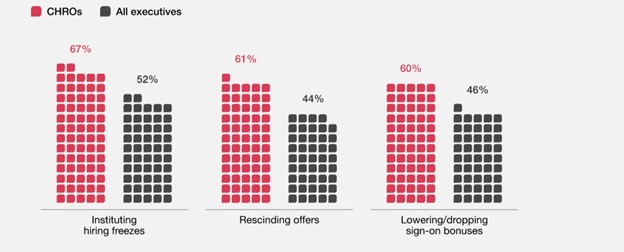
CHROs indicate a shift away from employees’ market
Source: PwC Pulse Survey
Easing public health problems have also contributed to reversals in some policies. While 62% of respondents had implemented vaccine mandates earlier, today, 34% have dropped these mandates, and 33% are willing to do so. Concern for in-office employee safety regarding COVID-19 dropped to 24%.
What HR leaders can do
Leaders must be flexible. They should determine where in their workforce further investments would be helpful and prioritize.
Flexibility Is the Norm
Flexibility in when and where they work has been the demand of the workforce worldwide for the last two years. Many companies realized the necessity of work flexibility and started offering it as part of their employee experience, retention, and recruitment strategies. And this flexibility, along with expanded mental health benefits, is here to stay.
About 82% of CHROs said they had already implemented or intended to implement permanent remote work options for appropriate roles. This strategy benefits businesses in several ways, such as reducing real estate footprints and associated costs. About 65% of respondents said they would maintain or reduce real estate investments over the next year.
Similarly, the push for mental health benefits has grown, with 76% of CHROs saying they already had or intended to expand their offerings around mental health. With respect to specifically prioritizing talent initiatives in the next six months to a year, 28% would make wellbeing initiatives one of the top priorities.
What HR leaders can do
Leaders should be open. They should evaluate the roles requiring on-site or hybrid work and those that can be done remotely. They can hire valuable talent from cheaper labor markets when building teams that won’t need in-person collaboration.
See more: How to Leverage Data and Performance Management Tools During Uncertain Times
Employers Face Return-to-Office Challenges
Many companies are recalling their employees back to the office. However, they face certain challenges in this regard, with employee backlash and transportation being the top ones. Gas prices have gone up due to inflation and may continue to do so. About 31% of CHROs were concerned that insufficient local transport infrastructure might not be able to handle returning employees, or employees may not be able to afford transportation costs. Companies are also seeing the backlash from employees who got used to working remotely. In some cases, employees even quit their jobs when asked to return to the office. According to an ADP Research Institute study, 64% of people would look for new jobs if they had to go back to the office full-time.
Besides these, CHROs have other concerns, including maintaining a fully staffed and stocked office, on-site employee safety, and availability of dependent care.
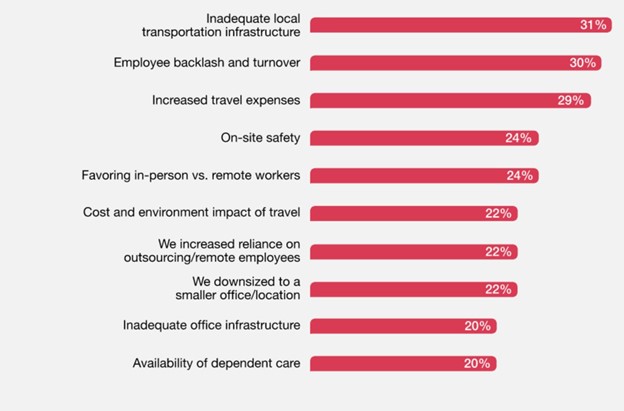
CHRO concerns as companies want employees to return to the office
Source: PwC Pulse Survey
What HR leaders can do
HR leaders should weigh their options carefully. They should evaluate what type of commute the majority of the staff takes. They should also if a fully-stacked office is required on all days. They should think about the availability and quality of amenities and their cost to the employees. They should also focus on creating a work environment that is inclusive of all employees irrespective of where they work from.
Looking Forward
As the business environment continuously changes, HR strategies, too, tend to change in line with company growth plans. That said, leaders should strive to implement sustainable policies focusing on attracting and retaining the right talent that fuels company growth. Such policies can help leaders sail uneven economic tides with fewer hiccups.
How do you think HR leaders can manage risks in a constantly changing business environment? Let us know on Facebook, Twitter, and LinkedIn.
MORE ON HR STRATEGY
Data Driven HR: The Key To Retaining Talent and Enhancing Employee Experience
Employee Retention Emerges the Top Priority for Employers Next Year
3 Ways Workforce Intelligence Solutions Will Deliver Long-Term Rewards
The Future of Work Requires More Transparent Management
61% Senior Leaders Spend One-third of Their Day Solving Employee Churn Problem