4 Ways Automation Can Help Reduce Call Center Costs
Global trends are causing increasing disruptions to products and services. As a result, businesses must meet higher customer service demand. By integrating automation solutions with your call center services, you can reduce costs and improve customer experience, explains Richard Conn, senior director, search marketing, RingCentral.
Global trends are causing increasing disruptions to products and services. As a result, businesses must meet higher customer service demand. By integrating automation solutions with your call center services, you can reduce costs and improve customer experience, explains Richard Conn, senior director, search marketing, RingCentral.
Today, interruptions to daily business functions are becoming more frequent. Uncertainty has become the norm. In 2021, there’s a general trend towards working from home, with call centers using teleconference solutions instead of being based in an office. Your business needs to adapt to the rapid changes and combat loss of revenue.
Running an effective business means reducing costs as much as possible without losing efficiency. You’re probably minimizing your small business taxes, looking to reduce office rental fees, and searching for cheaper suppliers. However, there are internal methods to reduce costs too, and one area to look at is your call center.
Learn More: The Challenge of Data Silos in Virtual Contact Centers: How To Prevent Them
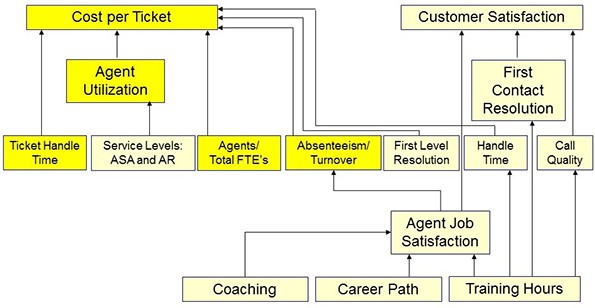
A flowchart breaking down call center cost per call factors
Image Source: HDAA
Whether you are using a physical call center or remote staff, it is time to look at effective ways to reduce call center costs per call. It’s important to have a clear idea of what you’re willing to compromise on. Customer experience is more important than it’s ever been, making it a balancing act between providing excellent service and reducing costs.
Automation can help businesses find a solution that reduces the cost per call while maintaining –[1] or even improving –[2] customer experience.
How To Automate and Reduce Costs?
One-third of customers expect a problem to be solved in one interaction. Almost two-thirds of customers stopped using a service after a poor interaction. Automation can save time and money and also improve the customer experience.
1. Automation with natural language AI
If you are a business utilizing a call center, you are likely to use IVR (Interactive Voice Response). This is an effective first line of automated support that can divert callers to the right agent for a solution.
However, standard IVR can only handle a small number of customer responses. It also cannot become more efficient over time, like machine learning, without a full team to manage the data.
Cognitive IVR can engage callers in natural conversation-based language. Deployable in days or hours, it can reduce costs by up to 85%. This is because cognitive IVR can handle a wider variety of calls that would normally require a live agent.
Machine learning and conversational IVR save time by resolving caller concerns. As an example, a customer may be calling to check on the status of a refund. With traditional IVR, the acceptable responses will be limited. But the customer will get transferred to a direct line related to refunds.
However, machine learning will be able to prompt the caller,
“Are you calling about your recent returned item?”
“Yes.”
“We have received the request and the money will be sent to your bank account within five business days.”
Problem solved. The customer has the information they wanted. No escalation to a live agent or supervisor was necessary. Machine learning provides an effective solution for reducing staff. It gives the customer a positive and frustration-free experience.
Machine learning doesn’t have to focus on speech response; it can also similarly integrate with text and chat messaging. SMS texts can be a simple method for diverting customers from using up man-hours. This is a good option to provide 24/7 customer support for less urgent questions or common requests.
Along with SMS, it’s worth adding chatbots to your mobile and online services. Similar to traditional IVR, there are rules-based chatbots that can handle a set of pre-programmed questions and provide pre-set responses.
As the first line of contact, these chatbots can be helpful to reduce the load on your call center staff. These chatbots can handle your most frequently asked questions. They can also be set to initiate contact with a live agent for more complex calls.
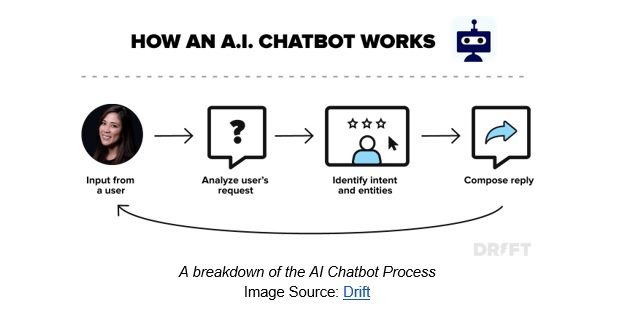
However, you gain increased benefits from implementing AI chatbots. With complex speech recognition, the AI will learn and be able to deal with a growing number of calls. Effectively, the AI becomes smarter. And not only can it handle more calls, but the AI can also save time by making accurate predictions of what users are looking for.
Automating your first line of contact will greatly reduce the workload on your call center team. This not only reduces labor costs but improves the availability of agents for the callers who need them. Lowering customer call waiting times greatly improves their experience.
2. Canceling and rescheduling customer bookings
Again, due to increasing uncertainty, cancelations will be more likely to occur. In this case, a large spike in call volume may occur.
With machine learning, not only can it be predicted, but it will be in place to disseminate the information most callers need, thus sparing your agents to handle more complicated calls. This type of automation improves your customer service and customer experience.
As the spike in call volume will be from callers with similar issues, it will be easy for automation to handle the calls. Customers will be able to cancel without needing an agent. The automation will predict they need a cancelation and provide a calculated solution.
Callers can be given the option to be contacted for rescheduling when business returns to normal. Or in a different scenario, customers can have the option to reschedule the appointment or booking immediately with AI.
3. Predictive staff scheduling

For over a decade now, businesses have been using workforce management solutions with the aim to reduce idle time and raise the productivity of call center staff. There are several ways to automate workflow to increase conversions. Automating staff scheduling can do that and also reduce costs.
Machine learning and automation streamline callers arriving at their destination. With automation, you also gain access to new information and data systems.
There are many automation tools that can transcribe caller interactions into text. This data is valuable to learn about customer behavior, learn what produces positive and negative experiences for customers, and segment various customer presentations so that problems locate to the best solutions. Customer problems can be resolved by the automation itself or by a live agent.
But that’s not all. The AI can also learn from this data to predict call volume patterns. This will enable you to prevent being stretched too thin by large call volumes or overstaffing. What does this mean? It means you can reduce your labor costs. It also means preparedness for the high-volume periods. Keep wait times down, and improve customer experience. Essentially, everybody wins.
Traditional workforce management solutions require a team to manage and collect data. But with machine learning AI automation in place, staff costs are reduced once again. Time is saved, and your profit margin increases.
Learn More: Migrating Your Contact Centers to the Cloud? Follow These 5 Best Practices
4. Increase staff adherence and productivity
It’s no secret that staff adherence can be a major contributor to the loss of productivity with call center staff. Even call centers run with machine-like efficiency can expect agents to average around 11% idle time per shift!
Besides having AI in place to produce better staff scheduling, it can revolutionize staff adherence and increase productivity. However, it’s important to take employee happiness into account too, as overworking staff will also reduce productivity.
For example, automation enables a proactive approach to callbacks. Calls are scheduled during predicted low volume times or can also be reactive to observed trends in call volume.
An automation solution can also take advantage of idle time by prompting an agent to sit for a short training session. In fact, it has been found that staff training can be more effective in short 5-10 minute sessions as opposed to 30 minutes or longer sessions. Employees learn quicker and attain more job satisfaction.
Machine learning can prompt users to take early lunch or shift breaks, thereby maximizing low volume idle time and turning it into break time.
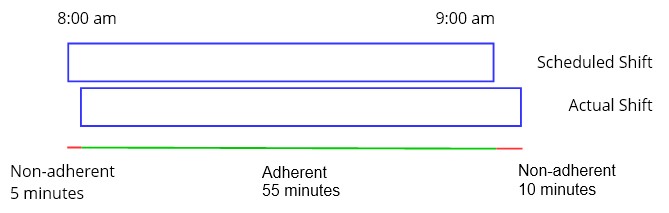
Chart showing difference between scheduled shift and actual shift times Image Source: CallCentre Helper
When a shift is trending against average volume, the AI can prompt a caller if they would like to clock out early. It can even be 5-10 minutes early, but the AI will have the average handle time for the agent. It will be able to decide if it’s worth keeping the agent on for another call or not. Saving 5-10 minutes per dozen or more agents can add up quickly! This can also help with preventing a large accumulation of overtime and loss of revenue.
Imagine how much time a supervisor would save by not having to fill out overtime payroll. Staff hours can be optimized. Machine learning and automation will reduce revenue losses and increase productivity.
Conclusion
Work-from-home culture isn’t going away anytime soon. Whether your business has its own call centers or uses a cloud-based service, it’s time to get with the program. In the modern time of working from home, you may already be implementing technology like video conferencing. But you can do more.
Save money and time by integrating an automation solution that works for you. Empower your employees to be more productive and gain more job satisfaction. And best of all, improve your customer’s experience!
What other ways do you think automation can reduce call center costs? Share with us on LinkedIn, Twitter, or Facebook. We would love to hear from you!