4 Ways Marketers Can Use Push Notifications To Increase Customer Engagement
Engaging users is as important as driving downloads for an app to succeed. Push notifications are an excellent way to boost in-app conversion rates, lifetime value, engagement, and revenue. Andrey Kazakov, president, Adjust, shares best practices to achieve optimal results with push notifications.

With 81% of Android users and 51.2% of iOS users opting to keep push notifications enabled on their devices, according to Airship, these alerts are essential for an app marketing strategy. As messages are sent directly to a user’s mobile device, app publishers can serve notifications to any user who has installed and has push notifications enabled on their device. Using this technique, you can send targeted, personalized messages without requiring the user’s contact information. It must, however, be approved by the user first.
Push notifications have also become more sophisticated over time. For instance, it is now possible to play personalized tones, send short messages, or display numbered badges over your app’s icon. There are many advantages to using notifications; however, it’s best to use them sparingly but cleverly.
While too many irrelevant messages can easily annoy your users, not enough messages can fail to engage them. This means that you will have to be strategic when developing your push notification strategy and finding the sweet spot. It’s also important to keep in mind that the perfect balance might differ from user segment to user segment, which makes testing and cohorting essential. Of users who open a push notification, 54% convert from segmented pushes, compared to only 15% who convert from bulk pushes, according to Upland.
See More: Top 5 Mobile App Marketing Trends to Watch for 2022
Here are four best practices to take your strategy to the next level:
1.Get creative when asking for permission
Regardless of how creative your push notifications are, they are worthless if users do not give you permission to send them. With users becoming more aware of their choices regarding their data privacy than ever before and regulations such as Apple’s AppTrackingTransparency framework now in play, asking for and getting permission is crucial.
To increase consent rates, you need to clearly communicate the value of your app’s experience for opted-in users and how targeted advertising can be highly beneficial (fewer ads that are more relevant vs. an increased number of seemingly random ads). From here, you can identify what is relevant to users and target them with tailored messages and updates. While you may be tempted to send a default permissions request to a new user right away, building a relationship with your user first is often better. Let them get to know you and trust your product first.
It’s also vital to ask permission at the right time, which can differ depending on your app’s vertical and segment. Ecommerce apps, for example, may want to ask for permission following a purchase. By doing this, you can highlight the value of push notifications. Here, the value would be the information about the shipment of the product.
It’s also important to note that although the official opt-in message is not customizable on iOS, you can create your own splash screen or pre-permission prompt. Take advantage of this opportunity and share your most persuasive (possibly tailored) creative to show why they should opt-in.
2. Provide users with actionable and valuable alerts
When sending a push notification, you need to ensure its value to your users. This is key in boosting engagement and retention rates. Your alerts should tell the user exactly what action needs to be performed and use a compelling call to action (CTA) to deliver this message. The CTA should invite the user to complete a specific activity or inform you about an update on something the user wants to follow. You can also send alerts with a call to value, designed to show users what they can gain, such as “add to watchlist” for an entertainment app and “Check in now” for a travel app.
Here’s an example of a push notification with an update from Skyscanner.

Example of push notification with an update
Source: Adjust
In this example, the user wanted to be notified when the price for a flight changed. This alert was sent the moment the price changed, and it provides all the information needed (the new flight cost and how much it has decreased) without wasting the user’s time. If users want to take the deal, they can open the app and book the flight directly by clicking. This alert is effective because it was requested by the user, offers valuable and beneficial information, and has an implicit call to action.
3. Personalize your push notifications
It’s not enough to create valuable notifications; you also need to identify how they add value to each user. By using personalized push notifications, you can ensure that you are targeting the right users at the right time with customized messages and optimal creatives.
Perfect your strategy in terms of the creatives themselves, frequency, delivery times, location, and content type. You will need to segment your audience into user groups, which will mean building multiple content strategies according to the kind of profile you’re targeting. It is also best to address the user by their name whenever possible and to include details relevant to your CTA.
You should also personalize your push notifications based on the user lifecycle. This means determining when a user will most likely need a push notification to take action.
Here’s an example of a personalized push notification from DoorDash.
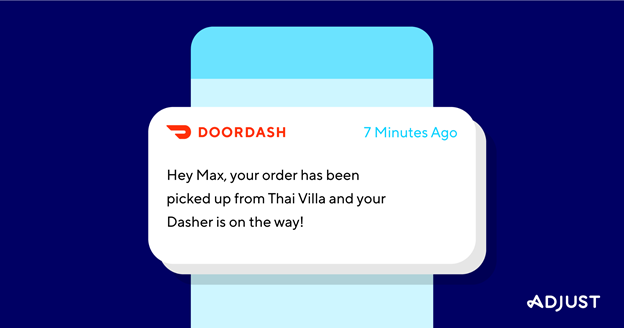
Example of personalized push notification
Source: Adjust
This notification from DoorDash gives the user a status update on their food, helping them feel more informed while waiting for their order. The push includes the user’s name, the restaurant they ordered from, and an emoticon for an extra friendly touch, making for a very personalized experience. We can also assume that once the user taps on the notification, they will see more information on the location of their order. Because this notification provides a timely update specific to their needs, users are more likely to engage with the app and keep coming back.
4. Test, optimize, and measure results
It’s crucial to test which type of CTA and creative works best for your audience and each user group. The best creatives should be selected through A/B testing. Your results may also vary depending on the message, delivery time, and the purpose of the push notification.
Push notification campaigns should also be measured and optimized over time. You can define KPIs related to your overall business goals, such as lifetime value (LTV), engagement, and return on ad spend (ROAS). After measuring and analyzing these results, you can find many ways to optimize your push notification strategy. By working with a mobile measurement partner, app marketers can track and monitor the metrics of push notification campaigns. You can also ask users for feedback on how they find the alerts useful.
See More: 4 Mobile Marketing Trends to Watch Out for in 2022
More Exciting Opportunities To Come
A push notification strategy has many benefits, with retention rate increases of as high as 3-10X, according to Airship. It’s a powerful tool for driving your app’s growth. By using these best practices and testing, you’ll find what works best for your audience. Push notifications will continue to evolve and develop, and we’ll be keeping an eye on the many opportunities to personalize and offer richer content for better results over the coming months and years.
Are you using push notifications? Let us know what benefits you have seen on Facebook, Twitter, and LinkedIn.
MORE ON MOBILE MARKETING