Cybersecurity Degrees: Types, Comparisons, and Best Practices for Selection
Acquiring a cybersecurity-focused educational program degree allows you to pursue one of the fastest-growing and high-paying careers in the world.
A cybersecurity degree allows students to pursue one of the fastest-growing and high-paying careers in the world of digital security. This article introduces you to the benefits cybersecurity degrees offer, the different types of cybersecurity degrees, and the best practices for selecting a suitable degree.
Table of Contents
What Does a Cybersecurity Degree Offer?
A cybersecurity degree allows students to pursue one of the fastest-growing and high-paying careers in the world of digital security. It is also called an IT security degree.
Cybersecurity is the process of protecting people, devices, processes, and technologies from malicious attacks and unintentional damage. With both personal lives and businesses increasingly going online, there is a growing worry about malicious hackers gaining access to sensitive data. A recent poll conducted by The Pearson Institute and The Associated Press-NORC Center for Public Affairs Research revealed that 9 out of 10 Americans are worried about their personal information getting hacked. United Nations officials have warned that cybercrime has increased 600% globally since the COVID-19 pandemic began.
Businesses have wised up to these concerns, and the demand for cybersecurity officials to mitigate cybercrimes is skyrocketing. However, there is a shortage of 2.93 million cybersecurity professionals worldwide, according to a study by International Information System Security Certification Consortium (ISC2). Added to this is the fact that the U.S. Bureau of Labor Statistics predicts a 28% job increase in this field by 2026.
All these facts indicate that this is the best time to start pursuing a career in cybersecurity. A cybersecurity program prepares students with the technical and managerial know-how to mitigate cybercrimes and control the effects of a cyberattack that may have leaked through a security system. Requirements for these degrees range from a high school diploma to a bachelor’s degree, based on the type of job one is looking for.
Cybersecurity degree programs commonly cover topics such as computer programming, intrusion detection, networking concepts, vulnerability assessment, malware prevention, and security event management. They also teach other crucial skills such as problem-solving and communication. According to the 2014 academic criteria of the National Security Agency (NSA), all cybersecurity courses must offer basic data analysis, introductory programming, networking concepts, IT system components, intro to cryptography, system administration, and legal and ethical compliance as part of the curriculum.
These skills can help you land jobs such as cybersecurity analyst, cybersecurity architect, security auditor, network administrator, and consultant. Other roles can include cybersecurity engineer, cybercrime investigator, and penetration tester. These jobs pay from $61,000 to $120,000, depending on the type of degree you pursue.
Technology and data aren’t going anywhere, which means that these skills aren’t going to become obsolete any time soon. A cybersecurity degree offers a solid career path spanning decades with immense growth opportunities.
Importance of a Cybersecurity Degree in 2022
Before we go into the details of what different cybersecurity degrees offer, here are a few reasons that emphasize the importance of gaining a cybersecurity degree in 2022.
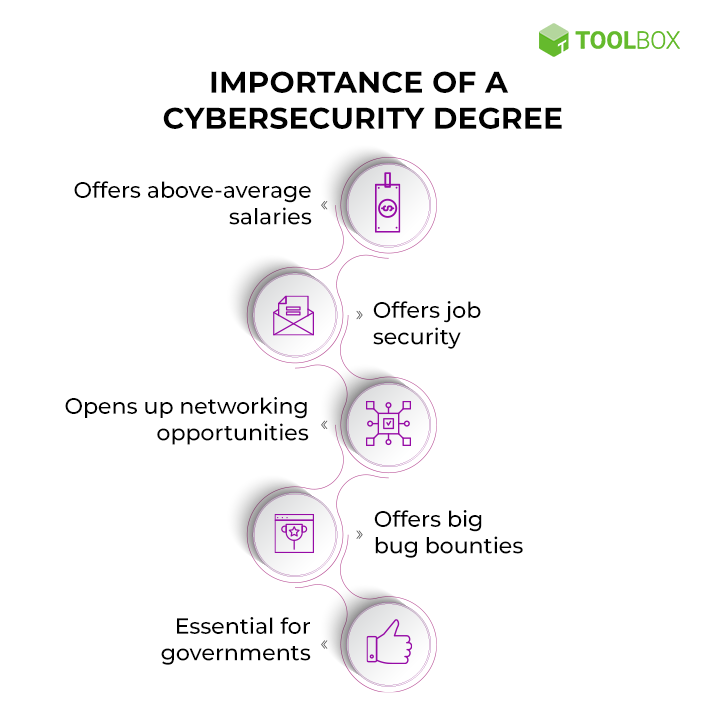
Importance of a Degree in Cybersecurity
1. Required by all industries
Many online transactions and sensitive assets are created every day in the education, healthcare, insurance, finance, and retail sectors. No matter the industry vertical, every business has crucial components exposed to the internet. Simple everyday applications such as email and collaboration software like Google Drive can expose valuable data. Business processes have been enmeshed with technology. Keeping this in mind, companies require cybersecurity experts on board, even if their prime offering is not purely technology-related. Besides, each industry now has privacy-related regulations that they need to adhere to.
2. Comes with many financial aid options
ISC2’s 2021 workforce study shows that the global cybersecurity workforce needs to grow 65% to defend organizations’ critical assets effectively. Governments that are targets of high-level, organized cybercrime and terrorism are waking up to the need for security analysts across their agencies. Many bodies offer good financial aid to students aspiring to acquire a cybersecurity degree.
For instance, the Center for Cyber Safety and Education offers many scholarships to those entering the field. Women who want to pursue this career path are also offered specific scholarships, with some even worth $10,000. Two scholarships funded by the U.S. government are the Information Assurance Scholarship Program and the National Science Foundation Scholarship for Service.
3. Offers above-average salaries
Due to high demand and the workforce gap, cybersecurity jobs pay above average, with an estimated median annual salary of $103,590 (as of May 2020). Salary.com reports an entry-level cybersecurity analyst’s salary to average $71,338 (as of October 2021). According to Payscale’s report, the average annual salary of a chief information security officer (CISO) is $165,291. With salaries as high as these, the cost of obtaining a degree can be recouped pretty quickly.
4. Offers job security
Technological advancements constantly modify and increase a business’s ability to produce and integrate. Consumers can now access applications from various devices, starting from a desktop computer to a smartwatch. This means that the attack surface available to a hacker has increased, with multiple entry points into the underlying system. This dynamic nature ensures that businesses will never run out of the need for cybersecurity experts. The infrastructure components may change, but the underlying cybersecurity concepts will remain the same.
5. Opens up networking opportunities
Obtaining a cybersecurity degree from a good university will allow you to connect with like-minded individuals. A good cybersecurity degree program also brings industry experts and organizes events for professionals at all levels to network. This, in turn, helps you find future opportunities and keep yourself updated with the current market happenings.
6. Offers big bug bounties through hacking contests
In 2019, Tesla offered $900,000 and a free car to anyone who could find bugs in the Tesla Model 3. This has become a norm — companies such as Google, Microsoft, Apple, and Facebook (Meta) also offer bounties to ethical hackers who can find vulnerabilities and holes in their systems. Some of these contests also translate into job openings if the company is suitably impressed with a person’s cybersecurity skills.
7. Essential for governments
A cybersecurity degree can be used in two domains: private industry and military. Governments acknowledge that sophisticated weapon systems are vulnerable to cyberterrorism. The U.S. Department of Homeland Security enlists the help of the National Initiative for Cybersecurity Careers and Studies to provide cybersecurity-interested veterans with support, toolkits, and free training.
See More: Career Path in Cybersecurity: How to Enter, Key Skills, Salary, and Job Description
Types of Cybersecurity Degrees
The first step in pursuing a career in cybersecurity is figuring out what kind of degrees are available and which one would suit your requirements the best. The different types of cybersecurity degrees on offer today are:
1. Associate degree
An associate degree is a base-level course that can be the first step toward a cybersecurity job. An existing associate’s degree is counted toward the first two years of a bachelor’s degree. It is a less expensive and quicker alternative for those who cannot afford a bachelor’s degree and would like to start earning faster.
- Degree earned: The associate degree may be an associate in arts (AA) or an associate in science (AS).
- Subjects covered: Some common subjects covered in an associate program for cybersecurity are fundamentals of infrastructure security, introductory programming, computer networking, database management systems, cybersecurity foundation, and system security.
- Requirements: To enroll in an associate program, applicants must have a high school diploma or a GED certificate.
- Duration of program: The associate’s program lasts two years.
- of credits: Students earn 60 credits.
- Average fee: The average fee of an associate degree varies from $3,570 in public institutes to around $14,580 in private institutes.
- Potential jobs: Potential jobs for associate degree holders include entry-level cybersecurity analysts and specialists.
- Average salary: The average salary of these jobs is around $61,625 to $64,984, according to the Bureau of Labor Statistics (BLS).
2. Bachelor’s degree
A bachelor’s degree can be the first step after high school if you have the time and financial resources. It covers cybersecurity specialization in more depth, thus awarding bigger responsibilities and higher salaries to bachelor degree holders than associate degree holders.
- Degree earned: A bachelor’s degree may be a bachelor in arts (BA), bachelor in science (BS), or bachelor in science and engineering (BSE).
- Subjects covered: The most common subjects covered in a bachelor’s program include introduction to programming, introduction to scripting languages such as Python, security risk management, visual and cloud security, computer networking, communications and systems management, and database management.
- Requirements: To apply for a bachelor’s degree, students must have a high school diploma or an equivalent such as a GED certificate and a minimum GPA. Most universities also ask for SAT or ACT scores and a personal essay.
- Duration of program: A bachelor’s program lasts four years.
- of credits: Students earn 120 credits.
- Average fee: The cost of a bachelor’s degree varies from $19,000 to $200,000.
- Potential jobs: Professionals with a bachelor’s degree in cybersecurity can get a job as an information systems analyst, security engineer, or security architect.
- Average salary: According to BLS, these specialists earn $71,930 on average.
3. Master’s degree
A master’s degree is for those who already have a bachelor’s degree and not necessarily cybersecurity itself. It is ideal for those who want to advance to higher levels of their job or switch to a cybersecurity position from an existing technical role.
- Degree earned: A master’s degree holder in cybersecurity has a master’s in science (MS) degree.
- Subjects covered: Master’s programs typically cover enterprise architecture, risk management, managerial courses, information security assurance, and cybersecurity management.
- Requirements: To apply for a master’s degree, one must have an existing bachelor’s degree with a minimum GPA. Applicants must also submit letters of recommendation and a resume. While some universities ask for GRE scores or require a bachelor’s degree, others require relevant work experience.
- Duration of program: A master’s program lasts between 18 months to two years.
- of credits: Master’s students earn 30-36 credits.
- Average fee: The fee for acquiring a master’s degree varies from $17,000 to $70,000.
- Potential jobs: Potential jobs for a master’s degree holder include advanced senior-level positions such as chief information security officer, security manager, security director, and information security consultant.
- Average salary: These jobs pay an average of $103,590, according to CyberSeek.
4. Doctorate
A doctorate is for bachelor’s or master’s degree holders who want more in-depth, research-oriented roles in the cybersecurity industry. Doctorates are a big commitment in terms of time and require a dissertation to be presented.
- Degree earned: Doctorate candidates earn a doctor of philosophy (Ph.D.).
- Subjects covered: Doctoral programs commonly cover software vulnerabilities and security, computer hardware and systems security, system and application security advances, assurance controls, and compliance management.
- Requirements: Doctorate applicants require a bachelor’s or master’s degree in a related field with a minimum GPA. Some universities also require letters of recommendation, writing samples, and a resume.
- Duration of program: A Ph.D. program typically lasts four to five years.
- of credits: Students earn 48-75 credits.
- Average fee: The cost of a doctorate is around $30,000 to $100,000. Most students apply for fellowships and assistantships to cover some of the costs.
- Potential jobs: Potential jobs for doctorate holders in cybersecurity include university teaching roles and advanced research positions such as information security consultants and research scientists.
- Average salary: These jobs earn an average of $165,000, according to Payscale.
5. Certificates
Though technically not degrees, cybersecurity certificates provide many benefits to those seeking to enter or move ahead in the cybersecurity field. These can be done alongside part-time or full-time jobs and do not have as many requirements as the other degrees. The only downside to certificates is that they expire after a certain period. However, this means that certificate holders are constantly up to date on current cybersecurity trends while renewing them. The most reputed certificates are CiSSP and CompTIA A+.
- Degree earned: Instead of degrees, certificates are earned.
- Subjects covered: Subjects vary from certificate to certificate; some examples are fundamentals of infrastructure security, ethical hacking, and computer forensics.
- Requirements: The requirements vary for each certificate. For example, CompTIA has no mandatory requirements, while CiSSP requires a minimum of five years of work experience. Those who don’t have work experience can apply for a pathway to the certification.
- Duration of program: Most certificates can be earned at your own pace.
- of credits: The number of credits varies based on the school or organization providing the certificate.
- Average fee: Costs vary anywhere from $50 to $700. The CiSSP certificate costs $699, while CompTIA A+ costs $340. Both expire within three years of earning them, which means this is a recurring cost instead of full-time degree fees.
- Potential jobs: Cybersecurity certificate holders can expect to land jobs as cybersecurity analysts, computer user support, and network systems admin. Advanced certificates can propel a cybersecurity professional to a higher-level job, such as a cybersecurity architect.
- Average salary: The varied nature of these certificates means that the certificate holders can earn anywhere from $66,000 to $164,000.
See More: Top 10 Cybersecurity Colleges in the U.S. in 2021
Top 7 Steps to Selecting the Best-Fit Degree for Your Career
There are multiple types of degrees and a large selection of universities to choose from. All these options can be overwhelming. To make things easier for you, here are the essential things to keep in mind while choosing a degree that fits your career path.
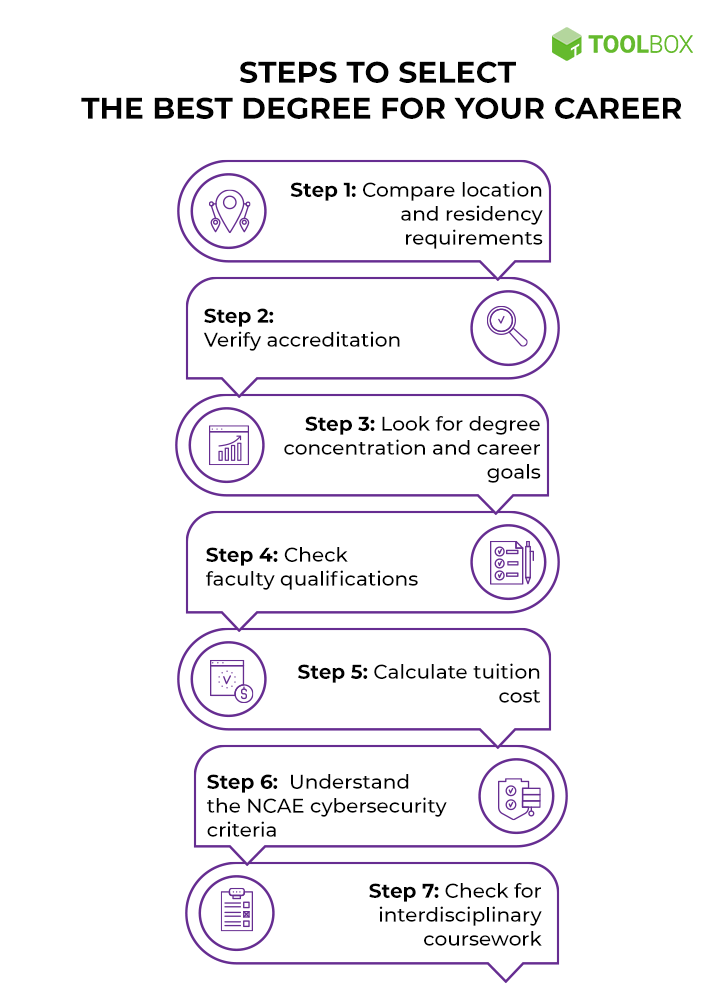
Steps to Select a Cybersecurity Degree
Step 1: Compare location and residency requirements
One of the first things to decide when considering a degree is how and where it can be obtained. There are currently three modes of earning a degree:
- Online courses involve fulfilling course requirements from anywhere in the world, enabled by recorded sessions, live video conferences, and online exams and submissions. These are ideal for those who work part-time or full-time and cannot afford to solely focus on the degree alone.
Online degrees are more flexible, and some online courses cost less than their on-campus counterparts, though not all. Interaction with colleagues and teachers happens through discussion boards or social media groups. They are flexible, though deadlines and exam dates are often fixed. Online degree-seekers also do not have access to campus resources and facilities, which is an important aspect to be considered. It is important to check the accreditation of the course while selecting an online degree.
- On-campus programs require that the student be present on campus for all classes, lab sessions, and assessments. This provides the most immersive experience for learning, though it is the most expensive of the three modes.
While picking such a degree, location becomes key. In-state public institutions have the lowest tuition rates. So if your current state has reputed public institutions with good facilities, that would be an ideal choice. Cost of living, commute and other factors also need to be considered.
- Hybrid degrees involve a mix of online and on-campus learning. Most hybrid programs have a minimum residency requirement. Some have online classes with synchronous weekend in-person classes. Some require students to choose which courses they will attend in which locations, while some spread the courses evenly. Hybrid classes give the flexibility of online learning for the most part while providing campus resources and facilities. This also allows more interaction with peers.
Step 2: Verify accreditation
Accreditation is the most important aspect while choosing a cybersecurity program. Accreditation directly influences financial aid, transfer of credits, and employment opportunities. Only accredited schools qualify for federal financial aid. Transfer of credits works only between accredited institutions, and unaccredited institutions do not enjoy the same privilege.
Accreditations aren’t just about the optics. They ensure that colleges meet the appropriate standards required for good quality of education. There are two types of accreditations:
- Regional: Regional accreditation agencies ensure high standards of faculty qualifications and student learning outcomes for state-owned or non-profit universities.
- Programmatic: Programmatic accreditors examine specialized and professional programs in a variety of fields and disciplines within institutions, as well as single-degree programs.
One example of accreditation is the Accreditation Board for Engineering and Technology, Inc., which provides the ABET accreditation for STEM courses. Students can search the ABET database to see if their prospective university is accredited.
Step 3: Look for degree concentration and career goals
Every cybersecurity program offers a specific concentration within the vast domain of cybersecurity. Those interested in a very specific career path must ensure that the program they choose matches these goals with the degree concentration. For example, those interested in the technology behind criminal justice (which lays the foundation for cybercrime) can look for a bachelor’s in ‘criminal justice with a crime analysis and cybersecurity concentration’, which is offered by universities such as the California State University.
Step 4: Check faculty qualifications
Having a good curriculum and world-class facilities does not mean anything if the faculty isn’t qualified enough to teach such advanced subjects. The US Department of Education has created the US Network of Educational Information just for this purpose so that aspiring students can gather information about schools, programs, and accreditations.
Step 5: Calculate tuition cost
Tuition costs depend on many factors, the first of which is the mode of education:- online, hybrid, or on-campus. Other factors that influence tuition costs are the prestige of the institute that offers the course, the type of degree, the location, and whether the school is public or private. As of today, the most inexpensive options are in-state public institutions.
While most degrees are not affordable, many scholarships, grants, and loans are available to students. Scholarships are usually based on merit; identities such as race, gender, or ethnicity; and athleticism. They do not require any repayment either. Grants also do not need repayment and are typically based on financial need. Loans are available and are subject to repayment with interest. They can be public or private. Public loans offered by the federal government tend to come with lower interest rates and more benefits than private loans.
Step 6: Understand the NCAE cybersecurity criteria
NSA’s National Cryptologic School runs the National Centers of Academic Excellence in Cybersecurity (NCAE-C) program to create and manage a collaborative cybersecurity educational program with community colleges, colleges, and universities. Universities can apply for an NCAE-C designation to show that they meet the standards set by the organization. There are three types of NCAE-C designations that a university can have:
- Cyber defense education (CAE-CDE): These are regionally accredited schools that offer cybersecurity certificates or degrees at the associate, bachelor’s, or master’s levels.
- Cyber research (CAE-R): These institutions include regionally accredited, four-year schools that qualify as R1, R2, or R3 universities under the Carnegie Foundation’s basic classification system. Military academies that offer doctoral programs and Department of Defense Schools can also receive this recognition.
- Cyber operations (CAE-CO): These are schools with technical, hands-on, and interdisciplinary programs in computer engineering, computer science, or electrical engineering.
Step 7: Check for interdisciplinary coursework
A good cybersecurity program doesn’t just provide programming and technical domains courses. Cybersecurity professionals also need good problem-solving skills, combined with the ability to think on their feet while looking at things from a wide angle. To hone these skills, the best cybersecurity programs offer courses on managerial skills, technical writing, and communication and also address legal and ethical issues surrounding technology.
See More: Cyber Threat Analyst: Key Job Skills and Expected Salary
Takeaway
Cybersecurity is an exciting and evolving field, which means that aspirants need to navigate relatively new waters. This domain involves a lifelong commitment to learning because of its dynamic nature. It may also involve personal investment in hardware and software, especially during the learning phase. This is why picking the right program is essential. The earning potential of a cybersecurity job makes up for any investment in this lucrative career path.
Did this article help you figure out your next step for a career in cybersecurity? Tell us on LinkedIn, Twitter, or Facebook. We would love to hear from you!
MORE ON CAREERS AND SKILLS
- Career Path in Cybersecurity: How to Enter, Key Skills, Salary, and Job Description
- Cyber Threat Analyst: Key Job Skills and Expected Salary
- Top 10 Cybersecurity Colleges in the U.S. in 2021
- Cloud Computing Careers: Job Roles and Key Skills Needed for 2021
- How To Pick the Best Data Science Bootcamp to Fast-Track Your Career