Is technology a good career path? The pros and cons of a job in IT


Pursuing a career in information technology (IT) holds a certain appeal for many computer enthusiasts. Not only do tech jobs promise opportunities to get hands-on with interesting business tech, but they often offer above-average wages.
But is technology a good career path for you? We’ve gathered real-life feedback from IT professionals in the Spiceworks Community who know what working in tech is really like, both the pros and the cons.
Is information technology a good career choice?
For decades, schools, public officials, and even well-meaning but annoying family members have urged job hopefuls to pursue a tech career —and for good reason. In my article on future-proof tech careers, we highlighted multiple tech jobs that command six-figure salaries, with the Bureau of Labor Statistics projecting rapid employment growth over the next decade.
But as they say, money isn’t everything.
When we recently polled almost 500 IT professionals in the Spiceworks Community about whether information technology is a good career path to follow today, they didn’t hold back on the good, the bad, and the ugly.
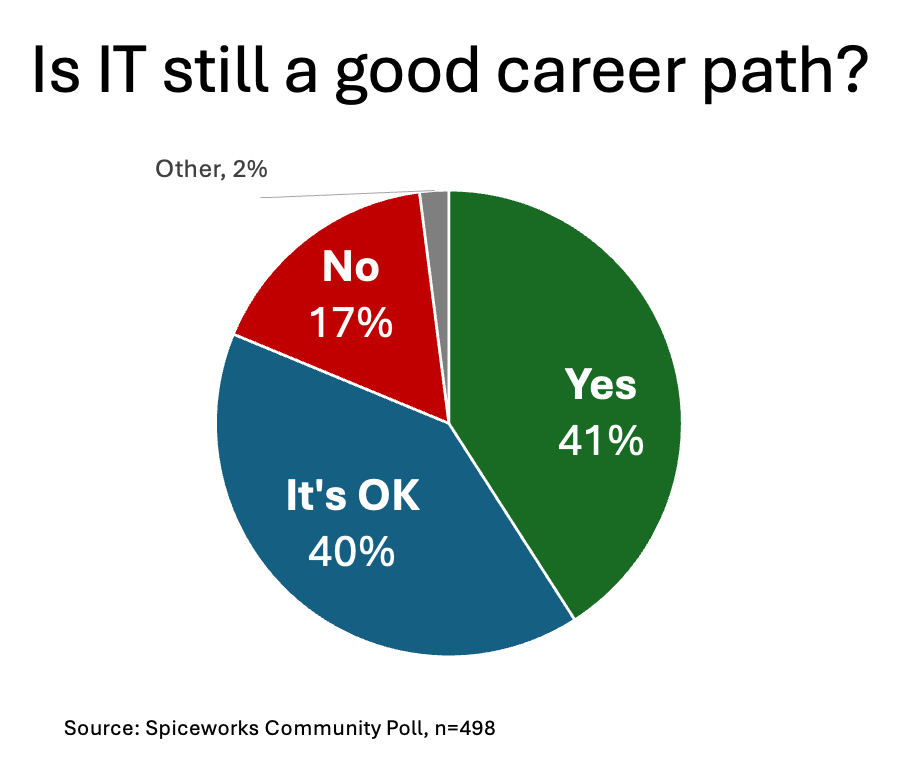
You might be surprised at the lukewarm or even negative sentiment towards working in IT, given tech’s reputation for generous compensation. However, the truth is that working in tech is not for everyone, and it requires a specific type of person to thrive in the field.
Pros and cons of a career in IT
While the appeal of high salaries and potentially interesting work is strong, it’s crucial to understand that an IT career is not a walk in the park. Certainly, going into tech isn’t the right path for everyone.
Additionally, competition for entry-level positions can be fierce. Not only will you have to know your stuff, but you’ll also have to put in the work to secure a job in IT, especially if you don’t have prior experience. If you want to know if IT is a good career path for you, it’s wise to consider the plusses and minuses of working in tech to decide if the benefits of a potential career in IT outweigh the challenges you’ll likely face in gaining the qualifications for and performing the duties of the job.
Pros of working in tech
- Potential for job security: Growing dependence on technology across industries and digital-first corporate strategies ensures demand for skilled IT professionals will remain strong.
- Competitive salaries: IT roles generally pay well above median wages for all jobs, and according to Dice.com, tech salaries have kept up with inflation better than salaries in other professions over the long term.
- Innovation and impact: IT professionals help everyone get the most out of technology, while also playing a crucial role in how emerging tech shapes how we all work. Many IT professionals derive a sense of satisfaction by having a positive impact on others’ lives.
- Choose your own IT adventure: IT professionals can follow many IT career paths, allowing you to explore numerous industries and specializations (i.e., databases, cybersecurity, networking, software development, management, and more). Once you discover which direction suits you best, you can pursue the niche that aligns with your interests and strengths.
- Never a dull moment: If you’re up for a challenge, there’s always something new to explore in tech. Over the years, innovations like the internet, cloud services, smartphones, virtualization, and artificial intelligence have kept things interesting.
Cons of working in tech
- Constant learning curve: Computer technologies evolve at a dizzying pace. To remain relevant, professionals must commit to continuous learning (i.e., via certifications, workshops, industry publications, and online communities). To put it bluntly, you must update your skillsets and adapt to the current state of tech, or get left behind.
- High stress and pressure: Because IT supports the computer infrastructure powering our constantly-connected digital world, any interruptions to services can be viewed as a failure. The pressure to always provide a seamless experience can lead to high-stress environments.
- Potentially long hours: IT professionals may need to work overtime, including nights and weekends, especially during critical projects or system outages.
- IT teams can be underappreciated. Despite adding immense value (no modern business can function without the tech IT departments’ support), IT can be viewed as a cost to the company instead of an enabler of productivity and innovation. This bias can sometimes result in management penny-pinching when it comes time to set budgets.
- People-facing work can be a grind: For IT professionals working in a helpdesk or user support role, face-to-face interactions can be taxing, especially if the people you’re supporting are less than appreciative of the hard work you’re putting in. IT support professionals often receive the blame for outages outside of their control (i.e., when problems occur at the ISP or cloud service level).
Know that sometimes, what are pros for one person (e.g., the challenging nature of the job and opportunities to explore new technologies), are cons for another. But if you’re excited by the prospect of the positives, and not phased by the negatives that might discourage other prospective IT pros, you might just be a good candidate for a tech career. As Spiceworks Community member, kwelch007 put it: “People don’t choose IT. IT chooses them.”
Skills needed for a successful IT career
Working in IT demands not only the right tech knowledge but also strong problem-solving skills, an analytical mind, and the ability to pay attention to detail and work under pressure.
Interpersonal skills are also vital in IT, as they are needed when translating technical jargon for non-technical stakeholders, collaborating across teams, and empathizing with the challenges of your end users.
If you want to know if IT is a good career path for you, the following traits and abilities can contribute to your success in IT.
- Problem-solving: A natural curiosity and enjoyment of dissecting problems and finding solutions will help you work through tech challenges or fire-fighting exercises you might encounter.
- Analytical thinking: The computer apps and services powering our digital world run on overlapping types of infrastructure that depend on each other. If any one service or component goes down, the entire system could cease to function. The ability to understand and break down complex issues into manageable parts and apply logical reasoning is essential to the critical work of IT troubleshooting.
- Attention to detail: Small errors in configuration files, scripts/code, or even an Ethernet cable that’s not plugged in all the way can lead to big IT problems. Learning to observe, troubleshoot, take notes, and document processes can go a long way toward ensuring IT success.
- Patience and persistence: We aren’t going to lie. At times, working in IT can be frustrating. When the pressure is on, and the entire company is relying on you, it can require significant patience and a strong mindset (i.e., a refusal to give up) to power through a difficult issue.
- Adaptability: Constant change in technology requires a willingness to embrace new tools and methodologies. High-pressure situations require the ability to think on your feet and go with the flow instead of getting discouraged.
- Strong communication: The ability to explain technical concepts clearly to diverse audiences, both verbally and in writing, is highly valued. Whether you’re working with internal stakeholders, negotiating with vendors, sharing learnings with your team, or talking an end user through an issue, communication can help you get ahead.
- Ability to work on a team: Many IT projects are collaborative, requiring effective teamwork and interpersonal skills. Also, knowing how to get the most out of your team, especially in management is vital if you want to move upwards.
Important factors that contribute to IT career satisfaction
By now, you know that whether going into IT is a good career move depends a lot on you. Sure, tech jobs can pay well, but you also have to be a good fit for the role.
Additionally, tech job satisfaction depends a lot on the company you work for. A recent Spiceworks study showed that the top predictors of happiness in IT included supportive management, a good company culture, and the opportunity for career growth. According to one Spiceworks Community member,
: “What matters most is finding a good company, with managers that support IT. Once you do, it makes the path very appealing.”
It’s also important to keep things in perspective. Relative to other professions, many view working in tech as a great gig. According to IT professional, GeneralTsao: “I’ve had plenty of other careers other than IT, and IT is pretty sweet as far as working hours, pay, and respect, but then again all that depends on where you work… and their attitude towards you and IT in general.”
Is a tech career right for you?
While you may love tinkering with tech at home, when tech is your job, you have to be able to do it day in and out consistently, while grappling with some of the common struggles IT professionals encounter in the field.
Ultimately, when making the decision to pursue a career in IT (or not), you should be honest with yourself and ask yourself key questions so you know what you’re getting into.
Checklist: Is technology a good career path for you?
Deciding if IT is the right career for you involves honest self-reflection. If you want to determine whether you have what it takes, consider how many of these questions you can answer “yes” to.
- Do you enjoy solving complex technical problems?
- Can you power through frustration if the answer isn’t right in front of you?
- Are you naturally curious about how technology works?
- Are you a logical and analytical thinker?
- Are you patient and persistent when facing challenges?
- Are you comfortable with continuous learning and adapting to new information?
- Can you communicate technical concepts clearly to non-technical individuals?
- Do you have a good eye for detail?
- Do you work effectively under pressure?
- Are you a team player?
- Can you handle occasionally working long hours?
- Can you deal with the high expectations of maintaining constant infrastructure uptime?
If you answered “yes” to most of these questions, then a career in information technology could be a great fit for you. Also, you’ve probably also figured out that our checklist covers many qualities potential employers seek in an ideal IT candidate.
Closing thoughts: Is technology a good career path?
If you want to know whether a tech career is right for you, you have to determine if the pros outweigh the cons for you personally and if working in tech is something you want to do long-term.
On the pro side, the benefits are many: the potential for a high salary, a comfortable work environment, and the opportunity to work with technology every day (if that’s what you’re into). However, job challenges are perhaps more important to focus on, since they typically drive IT workers away from the field, even years after entering it.
Let’s close by looking at important reasons IT pros leave the profession, with quotes offering a realistic view of what you’re getting into when you decide to pursue a career in tech.
According to IT Team Lead, Matt Olan,: “In IT, constant change means you must continuously learn and adapt. There’s no point where you can say, ‘I’ve mastered this, now I can relax for the next 30 years. It’s a continuous cycle: Learn something new. Implement it. Almost immediately, it becomes outdated, and you start over. Not everyone thrives in this environment.”
Similarly, IT professional, jeffnoel spoke to the pressures of the job: “The biggest downside is that nothing ever reaches a steady state; it is a Sisyphean treadmill. Work is NEVER finished.”
But the downsides of working in tech can be managed, and you can have a rewarding career, despite the demands on your time. According to IT professional Chris Hone: “I have enjoyed my time in IT, it’s kept a roof over my family, I have made some great friends along the way, and it always keeps you on your toes… The biggest downside is the hours you work… I used to work 50 – 60 hours a week without fail. Nowadays, it’s down to roughly 40.”
To IT, or not to IT?
Now that you know the good, the bad, and the sometimes ugly of working in IT, we hope you have a better idea of whether technology is a good career path for you.
In the end, it’s really a personal decision that you should make after getting informed on the realities of the job and whether you’re a good fit. This means getting honest with yourself about your preferences, work ethic, and capacity to learn.
Join the conversation on this article in the Spiceworks Community.