Remembering how we got here on our first annual Tech Nostalgia Day


We’re kicking off a new holiday here at Spiceworks. It’s the internet, who says we can’t? Welcome, then, to the first annual Tech Nostalgia Day. As usual with these kinds of things, the big party takes place in our community, where you can compare notes about old tech with the rest of the Spiceworks faithful and also read some throwback conversations. I know I’m long overdue for a discussion on the best anti-virus software of 2007, so perhaps that will help you as well.
Tech nostalgia can often feel like a contest to determine who’s older, who lived in closer proximity to a tech hub, or who happened to know someone with a particular kind of access. I’m almost 50, Coleco headquarters was the closest thing to a tech hub where I grew up (some kids got to do game testing there, but I wasn’t one of them), and I happened to know my father, who was my primary in. All of that was a privilege, and I’m fortunate to have experienced it, just like I’m fortunate to still get to do this job.
My dad got into computers in the early 80s when being “good with computers” meant anything from simply owning a computer to working at NORAD. He taught computer education classes for post grads at Wesleyan University. He and some colleagues started the Connecticut Computer Society, which had its own newspaper. They also had a consulting business, Soft Industries, that worked a bunch of different businesses and institutions in Connecticut and New York. A great line of work to be in at that time, but all I really cared about was that it led to a rotating series of 1980s computer hardware in our home.
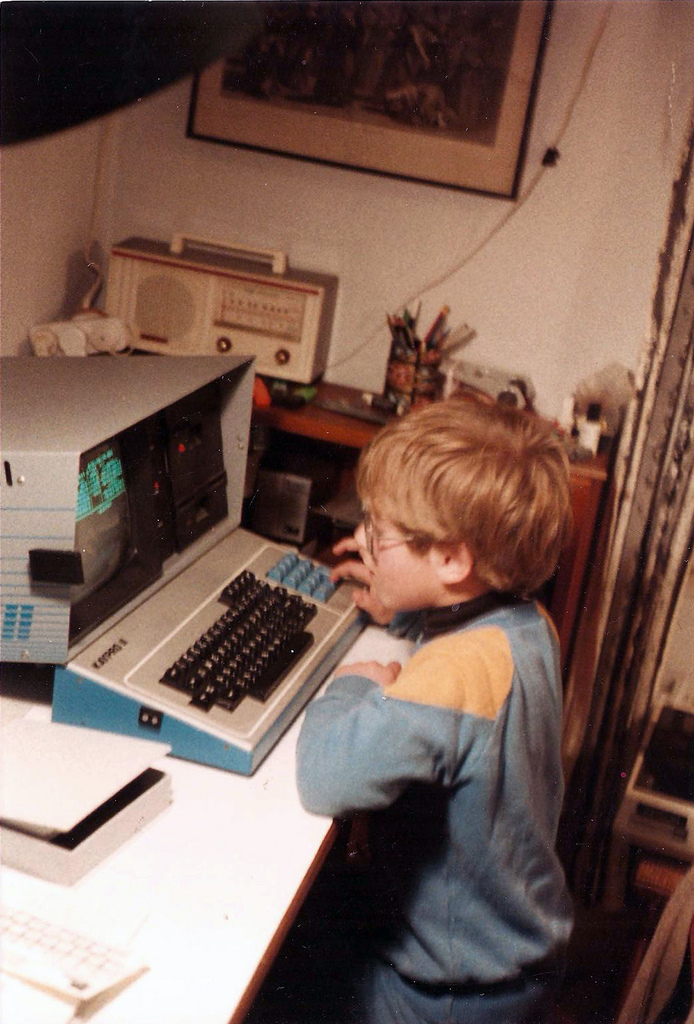
Not the author, but close enough. (Credit: Omer Simkha)
The cartridge-based Radio Shack TRS-80 was the one I remember best. It’s where I learned how to use word processing software. It was also had a decent game library for 1984. We had Coleco’s early game console/PC hybrid, the Adam (great for playing Buck Rogers: Planet of Zoom).
We had the 26-pound Kaypro II portable computer, and then an ongoing series of IBM and Apple desktops when they debuted. More than an early introduction to PC gaming, the experience provided early exposure to different user interfaces and their various keyboard shortcuts, menus, and general quirks.
Despite the “computer nerd” label that came with all that monochrome screen time, it also gave me confidence around computers that not a lot of people had back then.
My father and his colleagues pivoted to writing for the Ziff Davis magazine publishing portfolio (of which Spiceworks is currently a part), which then included PC Magazine, Computer Shopper, the Yahoo! Internet Life print magazines, and a few others, all of which I read avidly for anything game-related.
The late 1980s and early 1990s were a great time to get into the tech publishing business. It was around this time that PC Magazine commanded the highest ad rates of any mainstream print publication. There was so much work to be had that my mother, my brother, and I all became the beneficiaries of my Dad saying ‘yes’ to assignments and then handing them off to us to log our own bylines (my first was 50 words on the early MS-DOS game Ringworld: Revenge of the Patriarch back in 1993).
That was a lucky way to grow up. It led to my own career in tech publishing, which I’ve been fortunate enough to keep more or less afloat for close to 30 years. I’ve also quieted the part of myself that used to ask why I never parlayed that early computing exposure into a billion dollar software business. I like what I do, and I intend to keep doing it.
When you’re thinking about the tech you’ve worked with, or the tech you got to use over the years, remember to think about the circumstances by which you were granted that access. Good tech journalism helps us understand how technology affects our lives. Tech nostalgia can also help us keep our lives in perspective as we think about what we used, how we used it, and how both we and technology have evolved since.