IT pros and our own CTO sound off: The impact of AI on IT careers

Artificial intelligence promises huge productivity gains for businesses, but the technology is also controversial. While some praise AI for helping organizations do more with less, using AI in information technology has created uncertainty in the IT job market. For example, the CEO of Anthropic, Dario Amodei, recently predicted that AI will eliminate half of jobs at the entry level.
At the same time, a World Economic Forum (WEF) report says that even if it displaces jobs, AI will unlock new opportunities, leading to a net gain of 78 million jobs globally across all professions. But how might AI impact information technology careers, specifically? To understand how AI could alter the nature of their jobs, we gathered data and real-world quotes highlighting IT professionals’ perspectives on AI, including advice from a Chief Technology Officer (CTO) with extensive experience working with multiple AI tools.
How do IT pros believe their jobs will change in the age of AI?
While no one knows what the future holds for sure, one thing seems clear. AI use is growing, and there’s no stuffing the genie back in the bottle. In April 2025, OpenAI CEO, Sam Altman stated that 10% of the world uses ChatGPT, with user growth growing rapidly.
Currently, AI can complete some specialized tasks faster than people. However, even the most advanced models can’t understand or perform every task a skilled human can. Speaking to AI’s shortcomings, many IT professionals believe they can adapt and even thrive by developing people-oriented skills that aren’t easily replicated by machines. In a 2025 Spiceworks community poll, IT professionals were almost ten times as likely to say human skills will become more important in the age of AI, rather than less.
IT professional and Spiceworks Community member molan offered his thoughts on why people skills will grow in importance in the future: “AI, as it stands, makes things easier if you already understand the subject matter, know what to ask (with proper terminology), and how to implement what it provides. But if you don’t already know the subject matter, AI is just an exercise in frustration. It can’t actually do things for you (not yet). It won’t be replacing people until people who know nothing about a topic can ask it to do something and it can create and implement the entire request as a working solution.”
Will AI lead to more or fewer IT jobs?
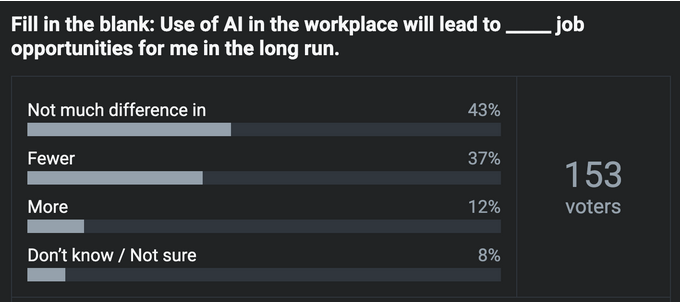
In 2025, IT pros’ opinions are split on the future impact of AI on their field. According to a recent Spiceworks poll, community members were three times as likely to say AI will lead to fewer IT job opportunities versus more over the long term. At the same time, the most common response was that AI use in the workplace won’t have much long-term impact on IT job opportunities.
IT professional, rtrauth2 was also skeptical, noting that AI can’t perform the hands-on work required of IT professionals: “I’ll worry about AI replacing humans when it can plug my computer into a wall socket. Until then, it is just another tool in the box. And, like all tools, it requires someone who knows how to use it.” Other IT professionals take the view that using AI in information technology might actually lead to net job growth. IT professional, Berto007 commented: “To maintain the servers and infrastructure to support AI there will be more IT jobs opening. Also, I see it more as a tool for employees to use more than it is going to replace them.”
Why some IT pros fear AI will replace IT jobs
While some IT professionals argue various IT functions can’t be replicated or automated by AI, some specialized skills could become less in demand. According to IT professional, Reg1145: “I saw one example of AI creating code. In 30 seconds, it took a COBOL program and file layout, modified the code, and produced the results that would have taken a person 2 days to produce. Then the person told the AI to convert the COBOL code to Java, and it did that in like 20-30 seconds. This is great, but terrifying at the same time. So, I can see how application specialists, software engineers will lose their jobs.”
Other IT professionals worry that business leaders will view efficiencies gained by AI tools as an excuse to reduce headcount. IT professional, Craigrrr commented that a “Harvard Business School paper was circulated this week stating that one AI-enabled person could perform as well or better than a two-person team. Don’t think for a second that businesses aren’t all over this with an eye towards reducing new hires by at least 50%.” Adding to this sentiment about potential for job losses, IT professional jeffjones11 stated that while AI isn’t necessarily replacing jobs today, it might as the technology improves: “I strongly suspect that businesses will really start to question the need to pay people to watch automated processes… especially once the next-gen sales pitch will be that AI is now capable enough not to need supervision.”
A Chief Technology Officer’s point of view on AI
With IT professionals’ feelings about AI’s disruptive nature in mind, it’s equally important to understand the other side of the business equation. To learn more about how those in leadership positions might feel about AI, we interviewed Joey Fortuna, the Chief Technology Officer of Ziff Davis (Spiceworks’ parent company), about AI use cases and how AI could change IT.
Fortuna believes that as users increasingly adopt AI-based tools for work, IT professionals will play a crucial role in bridging the knowledge gap between people and technology, just as they always have: “As AI gets smart enough even to do some of the stuff that IT staff are doing, IT becomes like the human intermediary between technology and the average employee. That’s an important role there’s no AI for.” Additionally, Fortuna says that IT professionals will need to gain big-picture expertise to provide context and understanding of an organization’s challenges and objectives to offset AI’s shortcomings: “At some point, AI is going to hit a limit in what it can answer or do. And it’s incumbent then on the human being that’s in the IT role to really have a solid understanding of our policy, an understanding of how to implement AI, and an understanding of what tools to use.”
A CTO’s take: Why will human skills matter more in the age of AI?
When AI can take over for simple IT support tasks, Fortuna believes IT professionals will have more time to focus on what really matters: “You can have AI field a lot of the requests that are just repetitive requests: How do I reset my password? How do I know if my printer’s not working? … An AI agent will be like, okay, I’ll do it for you. Bam, done … AI frees up the IT professional to do the more interesting things and to get in front of other issues that keep coming up.”
For example, as more office workers integrate AI into their workflows, Fortuna envisions the need for IT support to stay current on AI tools and understand which ones work best for a given task, because they’ll likely field many questions about AI-enabled tools. Having previously worked in an IT support role himself, Fortuna imagined future IT support tickets: “I don’t know how to use AI, and it won’t answer me in a way that makes sense, and no matter how much I search, it’s yielding irrelevant results. Can somebody sit down next to me and help me with this?”
Fortuna can picture a future where IT support would have more time to foster human-to-human connections with their peers while helping them with their tech challenges. “We’re going to keep needing people for that. Human support is the new technology, really. When you think about the companies that you really like in the world, they’re usually companies where you feel like you can get someone on the phone for a very specific and human answer.”
Fortuna postulates that in the future, IT professionals might “become like almost counselors at the field level, like boots on the ground who can talk the employee through this process … I think the character of the IT professional becomes increasingly human as AI becomes increasingly evolved.”
Additional AI opportunities and challenges in IT
Besides automating common support tasks, Fortuna has already seen efficiencies using AI-enabled tools that help IT save money: “Spotting trends in procurement would be one of the big IT use cases. How can we get smart about procurement and maybe advance or bulk purchasing things that previously we were buying one off and paying a premium for? AI can analyze the data and come up with a recommendation in a way that wasn’t really easily possible before, without a statistics person or a math person.” Speaking to AI’s ability to quickly analyze data to surface insights and trends, Fortuna says, “AI can say, here’s what the spend looks like across your organization. It looks like you’d do better if you did X or Y or Z, or you’ve only got so many users in this platform, but you’re paying for 50 licenses. You might want to go for lower-tier pricing.”
However, Fortuna also envisions challenges arising as AI tools rapidly advance, especially if departments or individuals want to use the latest and greatest AI tools without IT approval, without regard for security or privacy. “The idea of ‘shadow AI’ makes it really incumbent on IT teams to get involved, because frontline response happens at the policy level now, even in small and medium businesses, and certainly in the Enterprise. IT must develop a security and compliance policy around AI that clearly spells out what you can use, what you can’t use, what you can do, and what you can’t do.” Fortuna also has advice for organizations looking to tackle these challenges: “A couple of things have emerged as clear best practices. One is making sure that you have adequate data loss protection (DLP), and another is making sure that the AI vendors you engage with are contractually obliged not to use your data for training, or let your data otherwise get out there. And in order to really enforce that, you do have to centralize data to some extent, and you do have to make sure that the company policy is known generally.”
How to advance your IT career using AI tools
The introduction of AI could dramatically change the IT profession. Opinions are split as to whether technology will be good or bad for current IT pros or hopefuls looking to enter the field, but it’s clear that AI tools can enable organizations and individuals to do more with less.
Amid this shift — for the sake of their careers — IT professionals should prepare themselves for changes brought on by the use of AI in information technology. We’ll close with this advice from Fortuna, about how anyone can advance their career in the age of AI, as the barriers to creating fall as AI expands what’s possible: “One of the most common misconceptions about AI is that it’s the province of mathy people and science wonks. It’s really not … the new programming language is pure English, and AI is becoming increasingly accessible and easy to deploy … If you’re reasonably smart, you’re reasonably creative, you have reasonably good communication skills, and you’ve had a couple of years professional experience, and you have an eye for the right AI tool set, you can really succeed.”
With that AI advice in mind, remember these adages about IT: The only constant is change, and that if you want to stay relevant in the tech field, you must always keep learning.